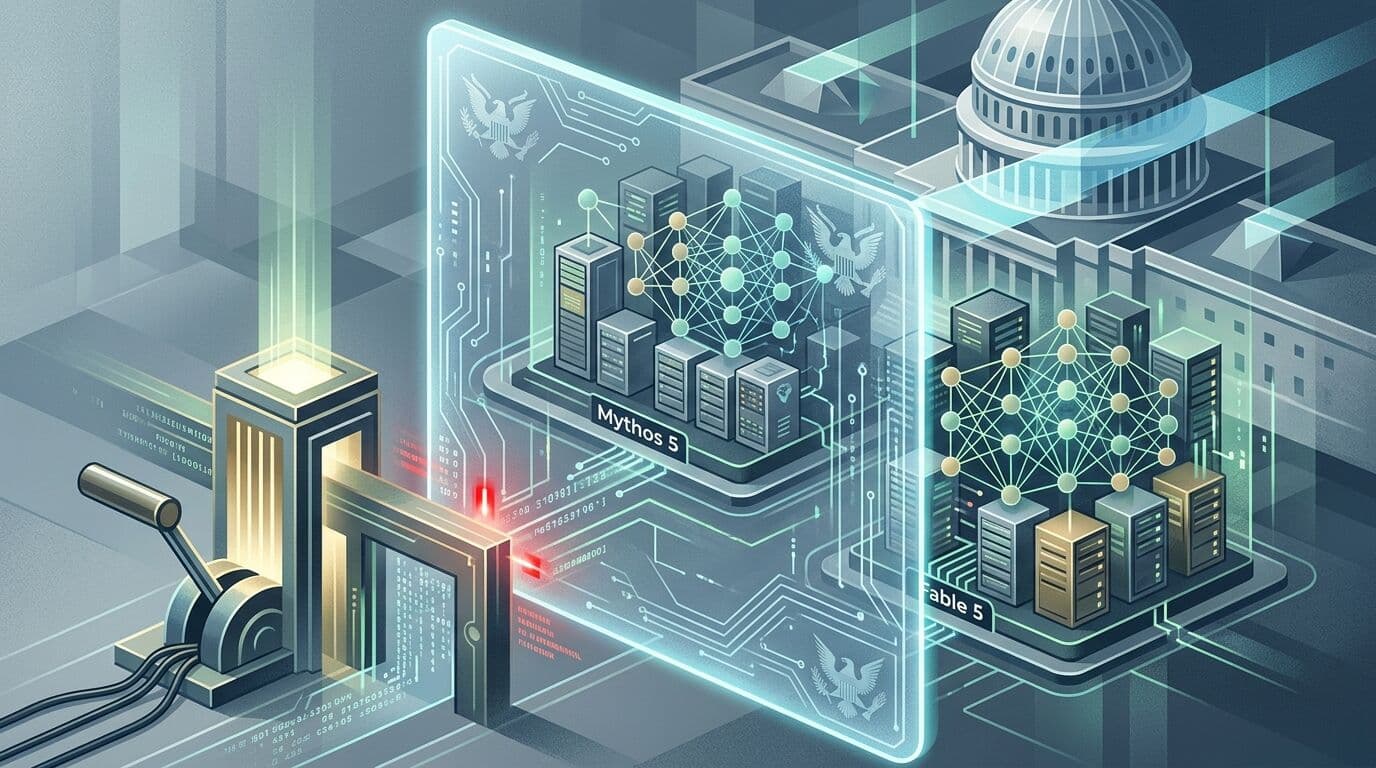
A Friday export control directive forced Anthropic to suspend access to its two newest flagship models, triggering a weekend of emergency negotiations with senior Trump administration officials.
Anthropic received a U.S. export control directive at 5:21 PM on Friday ordering it to suspend access to its Claude Mythos 5 and Fable 5 artificial intelligence models by “any foreign national” inside or outside the United States, including the company’s own foreign national employees, according to a source familiar with the situation. [1]
The directive gave Anthropic a 90-minute ultimatum to shut down access to both models or face export controls imposed by authority of the U.S. Commerce Department. [1] Anthropic executives were speaking with the White House within 15 minutes of that first call, and CEO Dario Amodei joined the discussions roughly an hour and fifteen minutes after it began. [1] Amodei spoke directly with Treasury Secretary Scott Bessent, Commerce Secretary Howard Lutnick, and National Cyber Director Sean Cairncross, in some cases more than once. [1]
Mythos 5 and Fable 5 are built on the same underlying foundation as Anthropic’s Mythos Preview model, which the company had previously described as too dangerous to release publicly. [1] Mythos 5 was made available to a select group of government agencies and companies, while Fable 5, which featured additional safeguards, was deemed “safe for general use.” [1]
The government’s concern centered on a reported jailbreak — a technique for bypassing a model’s built-in safety guardrails. [1] Anthropic said in a public release that it believed the government had “become aware of a method of bypassing, or ‘jailbreaking’ Fable 5,” but characterized the issue as a “potential narrow, non-universal” one that had been “shared with the government” by an unnamed entity. [1] The company also argued that the behavior was not unique to its models, stating it had “validated that the level of capability displayed there is widely available from other models (including OpenAI’s GPT-5.5).” [1]
Semafor reported, citing one source familiar with the matter, that the dispute originated from U.S. government concern that a China-linked group had accessed the technology. [1] That same source said the China concerns traced back weeks to a large global telecommunications company that had initially been cleared for access to Mythos Preview, and that Anthropic revoked that access immediately when the U.S. government raised concerns. [1]
Some reports pointed to Amazon CEO Andy Jassy as the person who flagged concerns to the government after researchers at Amazon red-teamed — that is, adversarially tested — Fable 5. [1] That account conflicts with assessments from independent red-teamers, who said they were impressed with the level of protections the model offered. [1] The source familiar with the negotiations confirmed that Amazon’s research was explicitly mentioned in conversations with the U.S. government, and said Anthropic had had access to the paper within days of the Friday directive and had been in ongoing discussions with Amazon researchers about it. [1] The source added that everything in that paper could be achieved using OpenAI’s GPT-5.5. [1]
Former U.S. AI and crypto czar David Sacks, who stepped down from that role in March, posted on X about the episode, describing the entity that surfaced the jailbreak as “a highly credible trusted partner of both Anthropic and the USG who was testing Fable [which] came forward with a jailbreak of those guardrails.” [1]
Anthropic flew a team of employees to Washington, D.C. over the weekend to negotiate, including Dave Orr, the company’s head of safeguards; Logan Graham, who runs its frontier red team; and Nicholas Carlini, a leading frontier developer and cybersecurity researcher. [1] Axios reported, citing a source familiar with the Trump administration’s thinking, that Anthropic “has not done a great job at trying to speak to the administration and appreciate the ideological differences.” [1]
The source familiar with the negotiations said Anthropic had pre-briefed the administration on Fable 5 before launch, and that the U.S. Department of Commerce conducted testing prior to deployment with no concerns raised at the time. [1] The source added that Anthropic had been working closely with government agencies since the release of Mythos Preview. [1]
The episode comes at a difficult moment for Anthropic, which had been counting on Mythos to help it recover from months of high-profile clashes with the U.S. Department of Defense. [1] The action has also prompted international calls for alternatives to American AI systems. [1]
A public letter from technology and cybersecurity executives called for restrictions on Fable 5 to be repealed on Sunday, arguing that any regulations should be rooted in “scientific evaluations developed with input from industry and academia.” [1] Alex Stamos, chief product officer at Corridor, told The Verge he organized the letter because the volume of software vulnerabilities requires AI to help patch them before bad actors can exploit them. [1] Stamos argued that the U.S. lead over Chinese AI competitors is narrower than policymakers assume: “The cutting-edge models are only something like six months ahead of the Chinese models — and those are the models we know about.” [1]
The public letter also contended that Fable 5’s safeguards “were so aggressive as to be the source of humor in the cyber community on launch day,” and that Mythos-class models are not “uniquely good” at finding or exploiting cybersecurity vulnerabilities. [1]
Sources
This article was drafted with AI from the cited sources and checked against them before publication. Spot an error? Let us know.