Anthropic bets on a lean, grep-based harness for Claude Code; Augment Code argues semantic retrieval delivers better results in large private codebases.
The most consequential design decisions in AI-assisted software development may now live not in the underlying models, but in the harness software wrapped around them — and two companies are making sharply different bets on how that layer should work [1].
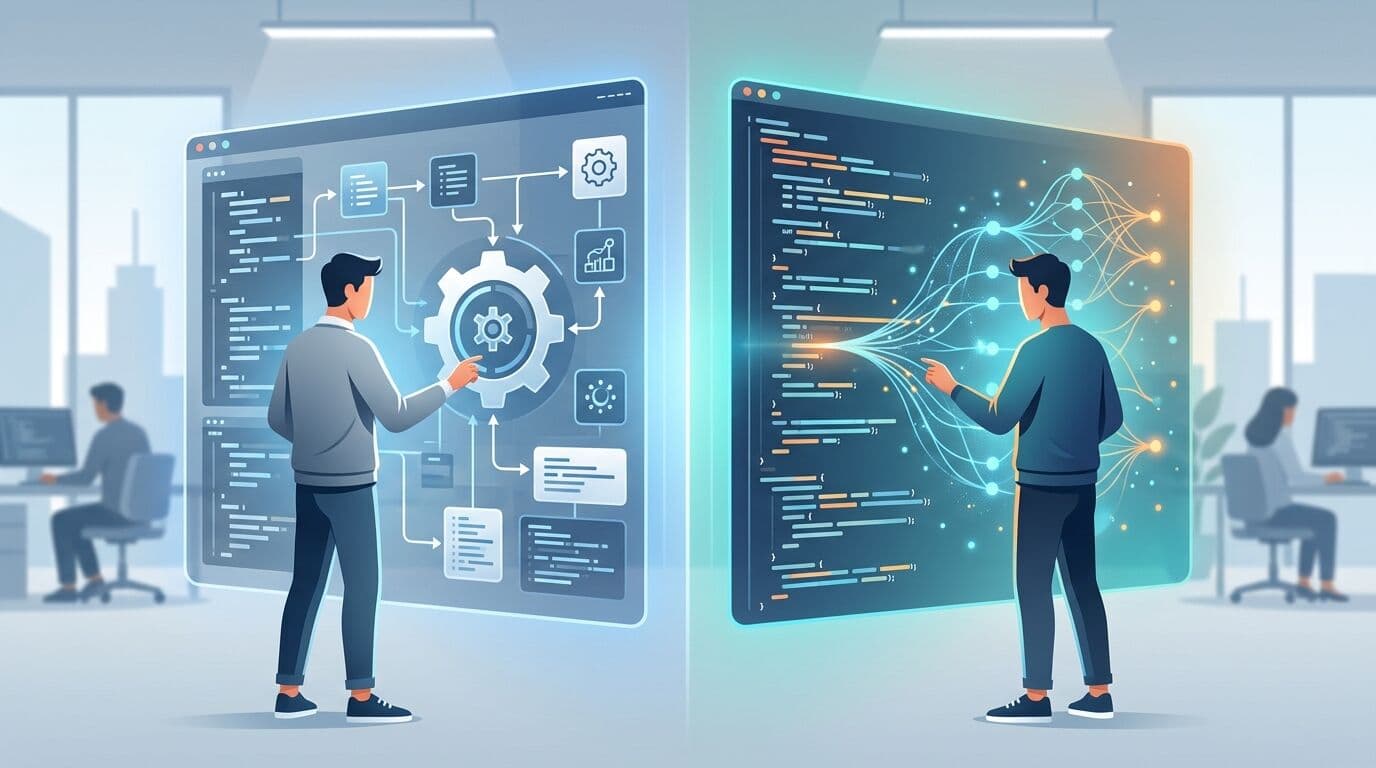
A harness is the software that determines what an AI model sees, what actions it can take, and how it interacts with a codebase [1]. As Ars Technica reported on July 20, the debate has sharpened between Anthropic’s Claude Code, which favors a minimal harness, and Augment Code, which pre-indexes repositories using semantic retrieval before an agent ever touches a task [1].
The lean harness argument
Cat Wu, head of product for Claude Code at Anthropic, told Ars Technica that the product team deliberately avoids building structured context around a codebase in advance by default [1]. Her reasoning centers on model velocity: because underlying models are improving so quickly, locking in opinionated features risks being overtaken by the models themselves [1].
On the question of whether semantic code-navigation tools produce measurable gains, Wu was direct. “Going by the evals, we don’t see a measurable change,” she said, adding that the team prefers “shipping a leaner harness with fewer opinionated tools and just letting developers add their own if they want” [1].
Claude Code’s current approach relies on grep-based context retrieval — pattern-matching searches through code — rather than semantic or vector-based methods [1]. OpenAI’s Codex takes a similar approach, according to Ars Technica’s reporting [1].
The semantic retrieval counter-argument
Augment Code, founded in 2022, spent roughly 18 months before the public release of ChatGPT researching retrieval and embedding models specifically for large codebases, according to Vinay Perneti, the company’s VP of Engineering [1]. The system pre-indexes a repository using an embedding and retrieval model pair, a vector database, and a back-end optimized to return results in sub-milliseconds [1].
Perneti argues the advantage is most pronounced in large, private codebases — precisely because public, open-source repositories are often already memorized by frontier models through training data [1]. “When you’re doing this in a private repo, a model has never seen that repo,” he told Ars Technica, explaining that semantic pre-indexing shortens the iteration loop for finding relevant code [1].
On token efficiency, Perneti pointed to a benchmark the company published: running Terminal-Bench with the same underlying model, Augment Code completed tasks at similar accuracy to Claude Code but used 33 percent fewer tokens [1]. He attributed the savings to spending less of the token budget on exploratory context-gathering [1].
Are they measuring the same thing?
When Ars Technica put Anthropic’s eval results directly to Perneti — that adding semantic retrieval tools showed no measurable improvement — he questioned whether the implementations being compared were equivalent [1]. “Not all retrieval systems are equal just like not all databases are equal,” he said, suggesting that a generic retrieval-augmented generation (RAG) implementation layered onto Claude Code would differ substantially from Augment’s purpose-built context engine [1].
Perneti also pushed back on the idea that rapidly improving model intelligence makes harness design irrelevant. His framing separates two ingredients required for quality outcomes: intelligence, which scales with model improvements, and context, which does not automatically improve just because a model gets smarter [1]. “How much of your token budget is going towards context gathering and producing the right outcomes?” he said, describing harness design as a systems engineering problem of balancing those two dimensions at minimum cost [1].
Beyond Claude Code and Augment Code, the harness space includes Google’s Antigravity, the open-source OpenCode, and Cursor, each with different design philosophies around how models are deployed in agentic workflows [1].
Sources
This article was drafted with AI from the cited sources and checked against them before publication. Spot an error? Let us know.