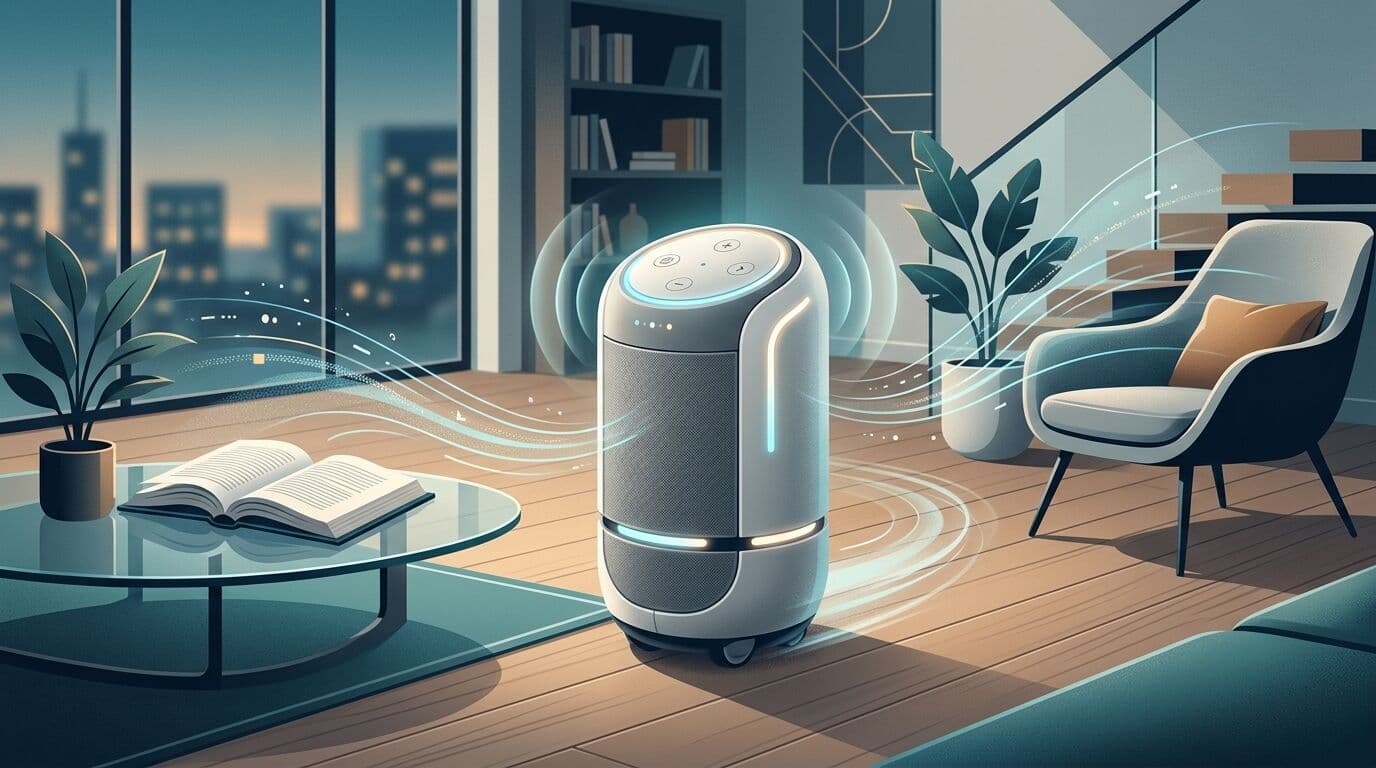
Bloomberg reports the AI company is developing a mobile, screen-free home speaker with a "personality" that learns about its owner — built partly by former Apple engineers.
OpenAI is developing a screenless, mobile smart speaker with built-in AI capabilities that can sync with ChatGPT and deliver home AI services, Bloomberg reported Tuesday [1].
The device matters for developers and AI product builders because it represents OpenAI’s first concrete step into consumer hardware — a category attracting enormous capital and one that could reshape how users interact with large language models (LLMs) outside of a screen [1].
What the device is
According to Bloomberg’s sources, the product is being pitched internally as a “humanlike AI companion that lives in the home” [1]. It is described as having a distinct “personality” and the ability to proactively learn about its owner over time, offering increasingly personalized responses [1]. The device would also have access to a user’s digital life — including emails — according to those sources [1].
One unusual detail: the hardware includes “mechanical elements that can move on their own,” and is designed to “feel like a companion and become a physical manifestation of OpenAI’s ChatGPT,” Bloomberg writes [1].
The product is still under development and no form factor has been publicly detailed [1].
Who built it and the legal backdrop
The device was developed with help from former Apple engineers who were instrumental in “creating products such as the iPhone and Mac,” according to Bloomberg [1]. That engineering pedigree, however, sits awkwardly alongside a fresh legal dispute: Apple sued OpenAI last week, accusing the company of stealing its trade secrets and claiming the allegations are “the tip of the iceberg” [1]. OpenAI has denied wrongdoing [1].
Bloomberg’s sources say OpenAI believes its new product “veers significantly from anything Apple has on the market today” and is “unlikely that it violates trade secrets” belonging to Apple [1].
Broader market context
OpenAI’s push into hardware comes as investor appetite for AI-native devices grows. Hark, an AI lab founded by Brett Adcock, raised an oversubscribed $700 million Series A in May at a $6 billion valuation to build what it calls “personal intelligence” — proprietary AI models paired with custom hardware intended as a “universal interface between humans and machines,” according to TechCrunch’s reporting [1].
OpenAI has previously floated the idea of launching its own phone, a move that would put it in direct competition with Apple [1].
Sources
This article was drafted with AI from the cited sources and checked against them before publication. Spot an error? Let us know.