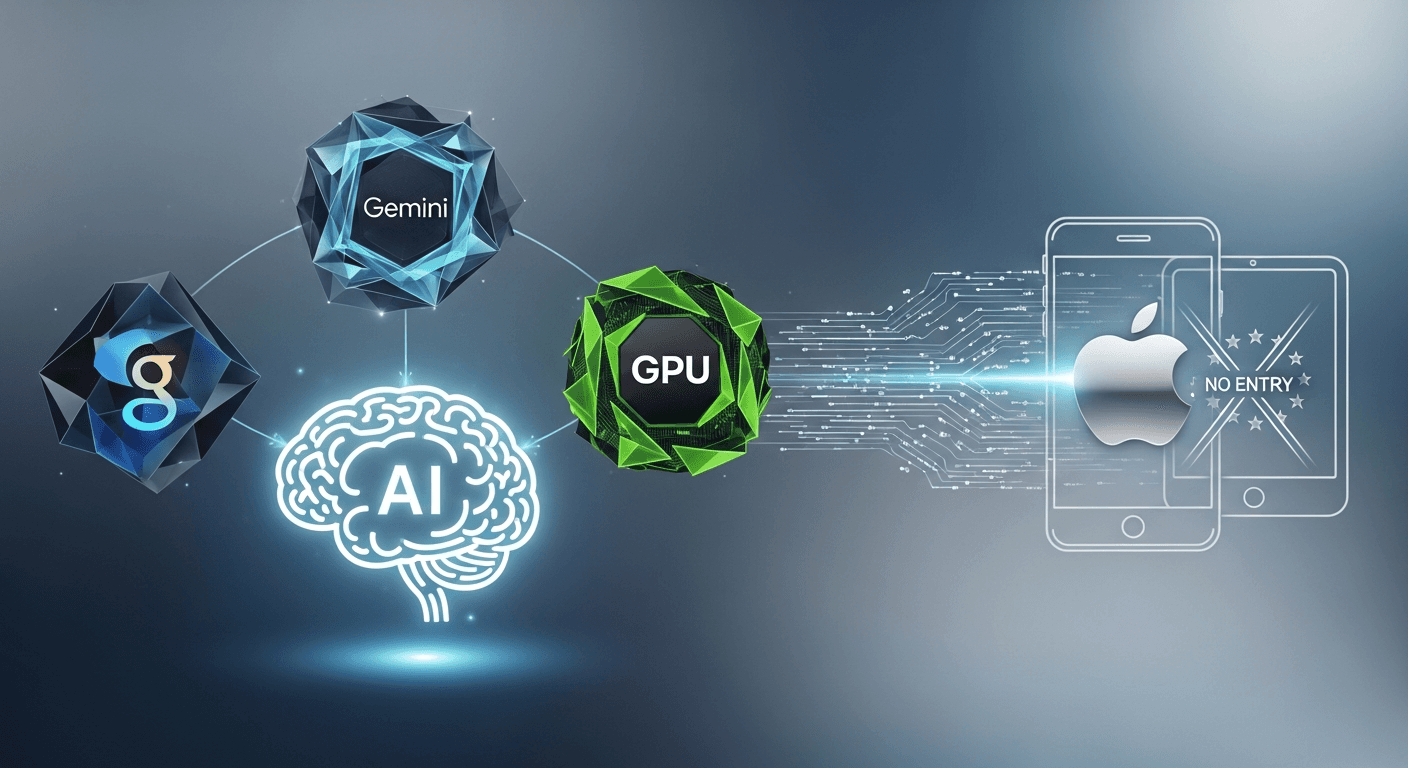
At WWDC 2026, Apple unveiled a ground-up rework of Siri powered by models built on Gemini technology and running on Nvidia GPUs for top-tier queries — but the feature won't reach iPhone or iPad in the EU.
Apple used its Worldwide Developers Conference 2026 to unveil what it calls “Siri AI,” a rebuilt assistant that can execute system-wide actions, read on-screen content, and draw on personal context from messages, emails, and photos. [1] A dedicated Siri app syncs conversations across devices via iCloud. [1]
The new assistant is built on Apple’s third-generation “Apple Foundation Models” (AFM), developed in close collaboration with Google and drawing on Gemini technology. [1] The lineup consists of five models: AFM Core, AFM Core Advanced, AFM Cloud, AFM Cloud Image, and the top-tier AFM Cloud Pro. [1] The four smaller models were trained for Apple Silicon and “refined using outputs from Gemini frontier models,” according to Apple AI lead Amar Subramanya. [1] Only AFM Cloud Pro actually runs on Nvidia GPUs, inside Apple’s Private Cloud Compute infrastructure, which has been expanded into Google Cloud for that purpose. [1]
Apple’s VP of software engineering Craig Federighi was careful to draw a distinction between the partnership and a product dependency: “The amount of the Google Assistant we use is none.” [1] Apple does not use the Gemini app, the models Google ships to its own customers, or Google Search as a knowledge base; world knowledge comes from Apple’s own “World Knowledge Service,” which the company says it built over several years. [1] Subramanya told CNBC that AFM Cloud Pro is comparable in quality to Google’s Gemini frontier models, though no benchmarks have been released. [1]
A component called the “System Orchestrator” routes each query to either on-device processing or the cloud. [1] Federighi described this router as central to the system’s privacy architecture. [1] Federighi also told CNBC that, unlike web-based assistants, Apple collects very little user data, relying instead on locally stored information such as calendars and messages for personalization. [1]
Hardware requirements are steep. The most capable on-device model requires an iPhone 17 Pro or iPhone Air, an iPad with an M4 chip and at least 12 GB of RAM, or a Mac with an M3 chip and 12 GB of RAM. [1] The standard iPhone 17, with 8 GB of RAM, does not qualify, nor does the iPhone 16 Pro Max. [1] Users without compatible hardware can still access many features through Private Cloud Compute, but with higher latency. [1]
New capabilities include a camera-based Siri mode that lets users point at a restaurant receipt to split the bill via Apple Cash or aim at a plate to receive nutritional information. [1] Visual Intelligence is also coming to visionOS. [1] Apple Intelligence will additionally be able to change compromised passwords automatically by navigating to the relevant website, logging in, and saving the new credential in the Passwords app, though Apple has not said how reliably this works in practice. [1]
For developers, Apple is opening up its Foundation Models Framework with support for image inputs, custom skills, and server-side model execution. [1] Xcode is also receiving an expanded coding assistant for agentic workflows. [1]
Geographically, Siri AI launches only in English-speaking markets. [1] In the European Union, the feature will not launch on iOS or iPadOS at all. [1] Apple attributes the exclusion to the EU’s Digital Markets Act (DMA), arguing the regulation would require the company to grant any third-party virtual assistant the same deep system access — including reading and sending messages, making purchases, accessing files, and triggering actions across apps — that Siri AI itself uses. [1] Apple proposed a “Trusted System Agent” middleware layer as a compromise, paired with an 18-month phased rollout, but the European Commission rejected that proposal along with every other one Apple put forward. [1] Apple has not given a timeline for bringing Siri AI to iPhone and iPad in the EU. [1]
The DMA’s scope creates an uneven situation across Apple’s platforms. Because the regulation designates only iOS and iPadOS as core platform services of a gatekeeper, macOS 27 and visionOS 27 will receive Siri AI in the EU. [1] watchOS 27, however, requires a paired iPhone with Siri AI active, meaning EU users will effectively be locked out there as well. [1] EU developers cannot test or integrate the new Siri AI features on iOS, iPadOS, or watchOS. [1]
The announcement comes nearly two years after Apple first demoed a personalized, context-aware Siri at WWDC 2024, originally planned for iOS 18. [1] The capabilities now shipping largely cover what was shown at that earlier event, arriving after what the source describes as major internal power struggles. [1] Tim Cook, who steps down as CEO in September and will hand the role to John Ternus, opened the keynote for the last time. [1]
Sources
This article was drafted with AI from the cited sources and checked against them before publication. Spot an error? Let us know.