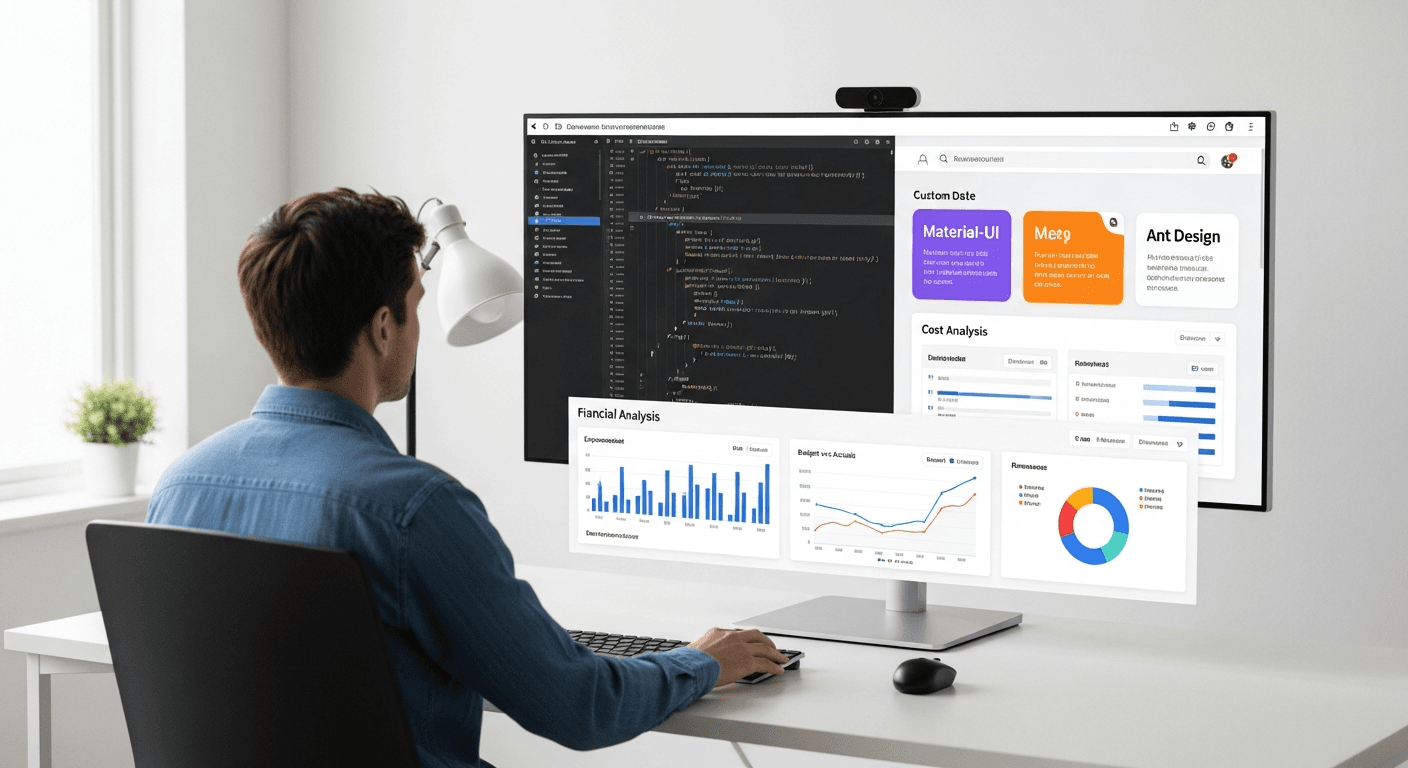
Most CTOs I work with make this decision backwards. They look at the upfront cost of a UI library — say, $500/month for a premium solution — and think “we can build this cheaper ourselves.” Six months later, they’ve blown through $23,000 in developer time rebuilding what Material-UI already perfected.
Here’s the framework I use to help small business tech leaders calculate the real ROI on this choice.
The Hidden Costs Nobody Talks About
When you’re weighing custom React components against pre-built libraries, the sticker price tells maybe 30% of the story.
I worked with a fintech startup last year that decided to build their own design system. The CEO saw Ant Design’s enterprise pricing and said “our developer can knock this out in two weeks.” That was March. In September, they were still fixing accessibility issues and responsive breakpoints.
The real cost breakdown looked like this:
- Initial development: 120 hours at $75/hour = $9,000
- Bug fixes and refinements: 80 hours = $6,000
- Accessibility compliance: 40 hours = $3,000
- Cross-browser testing: 30 hours = $2,250
- Documentation and maintenance: 35 hours = $2,625
Total: $22,875. For components that Ant Design would have provided for $99/month.
The Three-Factor ROI Formula
I’ve distilled this decision into three core factors. Each one carries different weight depending on your business stage.
Factor 1: Development Velocity vs. Control
Pre-built libraries get you to market faster. Period. But they also lock you into someone else’s design decisions.
Custom components give you complete control but slow initial development by 60-80% in my experience. The question isn’t which is “better” — it’s which trade-off serves your current business goals.
If you’re racing to validate a market or beat competitors to launch, velocity wins. If you’re building a differentiated user experience as your core competitive advantage, control might justify the investment.
Factor 2: Team Expertise and Bandwidth
This is where most small businesses fool themselves.
Building production-ready components requires expertise in accessibility, cross-browser compatibility, performance optimization, and responsive design. It’s not just “making divs look pretty.”
Ask yourself: Does your team have dedicated UI/UX resources? Can they handle ongoing maintenance without derailing feature development? I’ve seen too many startups where the “quick custom component” becomes a six-month engineering distraction.
Factor 3: Long-Term Maintenance Burden
Here’s what kills most custom component decisions: maintenance debt.
That button component you built works great today. But when iOS updates Safari’s rendering engine, or when you need to support right-to-left languages, or when accessibility standards change — who’s fixing it?
Pre-built libraries have teams dedicated to these updates. Your custom components have… whoever happens to be available when things break.
The $23K Decision Framework
I use this simple calculation with clients. It’s not perfect, but it’s surprisingly accurate.
Custom Component True Cost =
- Initial development hours × developer rate
- + Testing and refinement (add 40% of initial estimate)
- + Accessibility compliance (add 25% for basic, 50% for enterprise)
- + Annual maintenance (15-20% of total development cost, every year)
Pre-Built Library True Cost =
- License fees × project timeline
- + Customization hours × developer rate
- + Integration complexity (usually 10-30 hours for complex apps)
When the custom option hits $15,000+, pre-built almost always wins for small businesses. The $23K figure comes from real projects where teams underestimated by exactly that amount.
When Custom Actually Makes Sense
Don’t get me wrong — custom isn’t always the wrong choice.
I recommend custom components when:
- Your UI is a core differentiator (think Stripe’s dashboard or Linear’s interface)
- You have specific accessibility or compliance requirements that libraries don’t meet
- Your design system is so unique that forcing it into existing patterns would hurt the user experience
- You have surplus engineering capacity and view component development as an investment in team skills
But be honest about which category you’re actually in. Most small businesses think they’re building the next Figma when they’re really building another CRUD app.
The Hybrid Approach That Actually Works
Here’s what I recommend to most clients: start with a solid library like Chakra UI or Ant Design, then build custom components only for your unique features.
Use pre-built for the standard stuff — forms, buttons, navigation, modals. Go custom for the pieces that define your product experience — your main workflow components, specialized data visualizations, or industry-specific interfaces.
This gives you 80% of the velocity benefits with 20% of the risk. You’re not reinventing dropdowns, but you’re not constrained on your core product differentiators either.
Making the Call
The decision ultimately comes down to this: where does component development fit in your value chain?
If beautiful, accessible UI components are central to your competitive advantage — and you have the team to execute and maintain them — custom might be worth the investment. If components are infrastructure that enables your real value proposition, buy don’t build.
I’ve seen companies succeed with both approaches. But I’ve seen a lot more fail by choosing custom for the wrong reasons — usually ego or a misunderstanding of the true costs involved.
The $23K framework isn’t about the specific number. It’s about forcing yourself to count all the costs, not just the obvious ones.
Frequently Asked Questions
How long does it typically take to build a complete custom component library?
For a basic component library with 15-20 essential components (buttons, forms, navigation, modals), expect 3-6 months with a dedicated developer. Complex libraries with advanced components can take 8-12 months. Most teams underestimate by 40-60%.
What’s the break-even point between custom components and premium UI libraries?
Generally around $15,000-20,000 in development costs. If your custom solution exceeds this threshold, premium libraries like Material-UI Pro or Ant Design Pro usually provide better ROI over 2-3 years.
Can you mix custom components with pre-built libraries effectively?
Absolutely. This hybrid approach works well — use libraries for standard components and build custom for unique business logic. Ensure consistent theming and design tokens to maintain visual cohesion.
How do you calculate ongoing maintenance costs for custom components?
Budget 15-20% of initial development costs annually. This covers browser updates, accessibility improvements, bug fixes, and new feature additions. Don’t forget to factor in documentation updates.
What are the biggest red flags that suggest custom components aren’t worth it?
Limited engineering resources, tight deadlines, standard business requirements, or treating UI components as “quick weekend projects.” If your team hasn’t built production-ready component libraries before, the learning curve will be steeper than expected.
Which pre-built libraries offer the best ROI for small businesses?
Chakra UI offers excellent developer experience and customization. Ant Design provides comprehensive components out-of-the-box. Material-UI has the largest ecosystem. Choose based on your design requirements and team preferences, not just price.