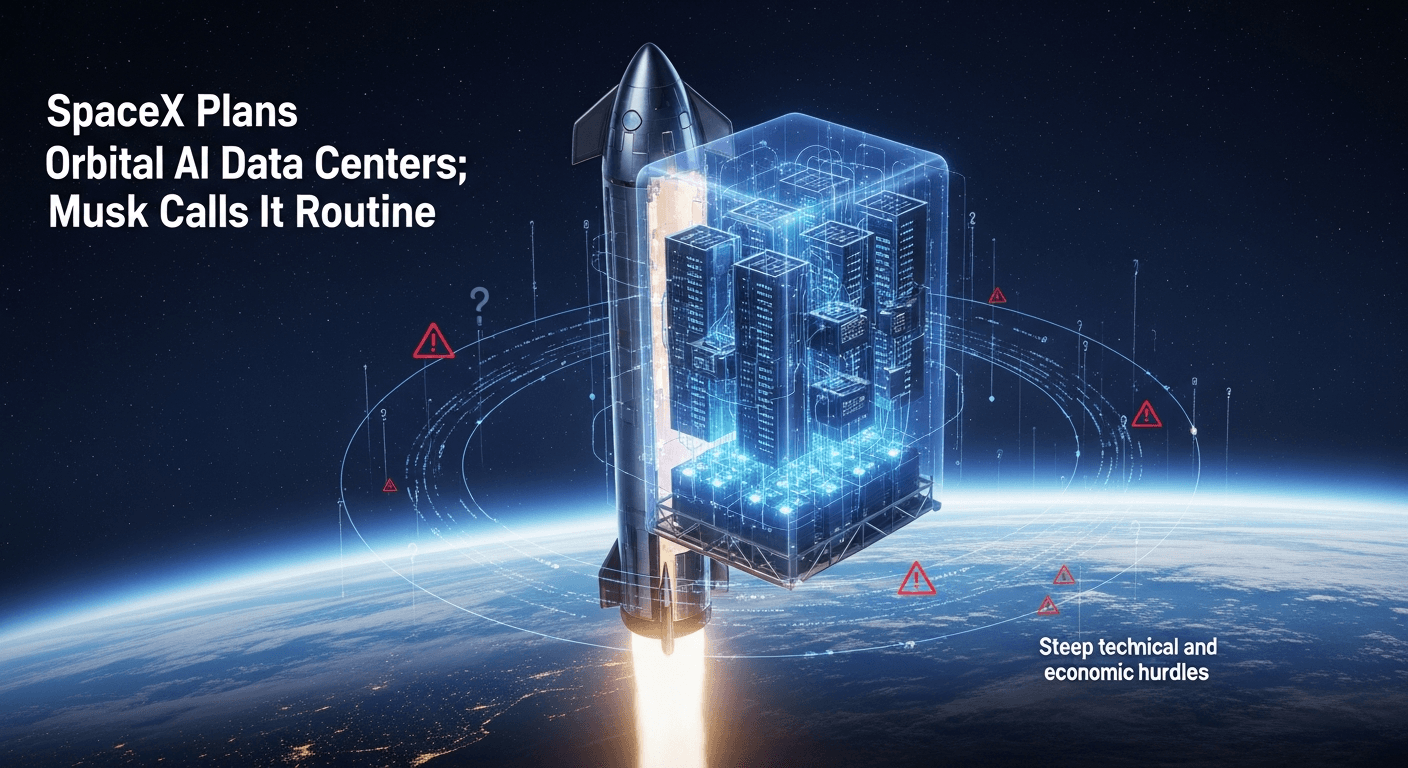
SpaceX is developing AI-capable satellites it says can run GPU workloads in orbit, but analysts and rivals point to steep technical and economic hurdles.
SpaceX has publicly outlined plans to place artificial intelligence data centers in orbit, with CEO Elon Musk framing the effort as an extension of technology the company has already developed for its Starlink satellite network. [1]
In a video discussion published by SpaceX, Musk argued that no fundamentally new technology is required: “A lot of this is technology we’ve already made for the Starlink V3 satellites. We don’t think this is a super hard problem compared to the things we already do.” [1]
According to Musk, the first AI satellite would deliver 150 kilowatts of peak power and 120 kilowatts of sustained compute — figures he compared to a single Nvidia GB300 rack, which draws approximately 140 kilowatts. [1] The satellites would shed heat by radiating it into space and generate power via solar panels. [1] SpaceX’s factory in Bastrop, Texas is targeted to reach meaningful production volumes by the end of 2027. [1]
However, the GB300 is not a standalone server. It is a tightly coupled supercomputer in which Blackwell graphics processing units (GPUs) are connected via NVLink — Nvidia’s high-speed interconnect — sharing terabytes per second of memory bandwidth. [1] That level of coupling cannot currently be replicated across satellites in orbit. [1]
Research from Google, described in a paper on orbital tensor processing unit (TPU) swarms nicknamed “Suncatcher,” illustrates the scale of the challenge. Matching the compute of a single one-gigawatt ground-based data center would require roughly 10,000 satellites flying in close formation, using free-space optical links to approximate terrestrial bandwidth. [1] Cosmic radiation also poses a practical problem, causing bit flips that can corrupt AI training runs. [1] Google’s analysis further suggests launch costs would need to fall to around $200 per kilogram to make the economics viable. [1]
SpaceX does hold relevant advantages: its Starlink program has already demonstrated mass-produced satellites, solar panels, thermal radiators, and laser crosslinks for data transfer between nodes in orbit. [1] For inference workloads — running a trained model rather than training one — where latency and bandwidth demands are more moderate, a single orbital GPU satellite passing results via laser link is considered technically feasible in the nearer term. [1]
Training large foundation models remains the harder problem, as it currently depends on tens of thousands of tightly coupled GPUs sharing coherent memory — an architecture that has no orbital equivalent today. [1]
Amazon founder Jeff Bezos has publicly stated he does not expect orbital data centers to undercut ground-based facilities on cost for up to 20 years. [1] SpaceX is currently valued at approximately $1.75 trillion ahead of a planned initial public offering (IPO). [1]
Sources
This article was drafted with AI from the cited sources and checked against them before publication. Spot an error? Let us know.