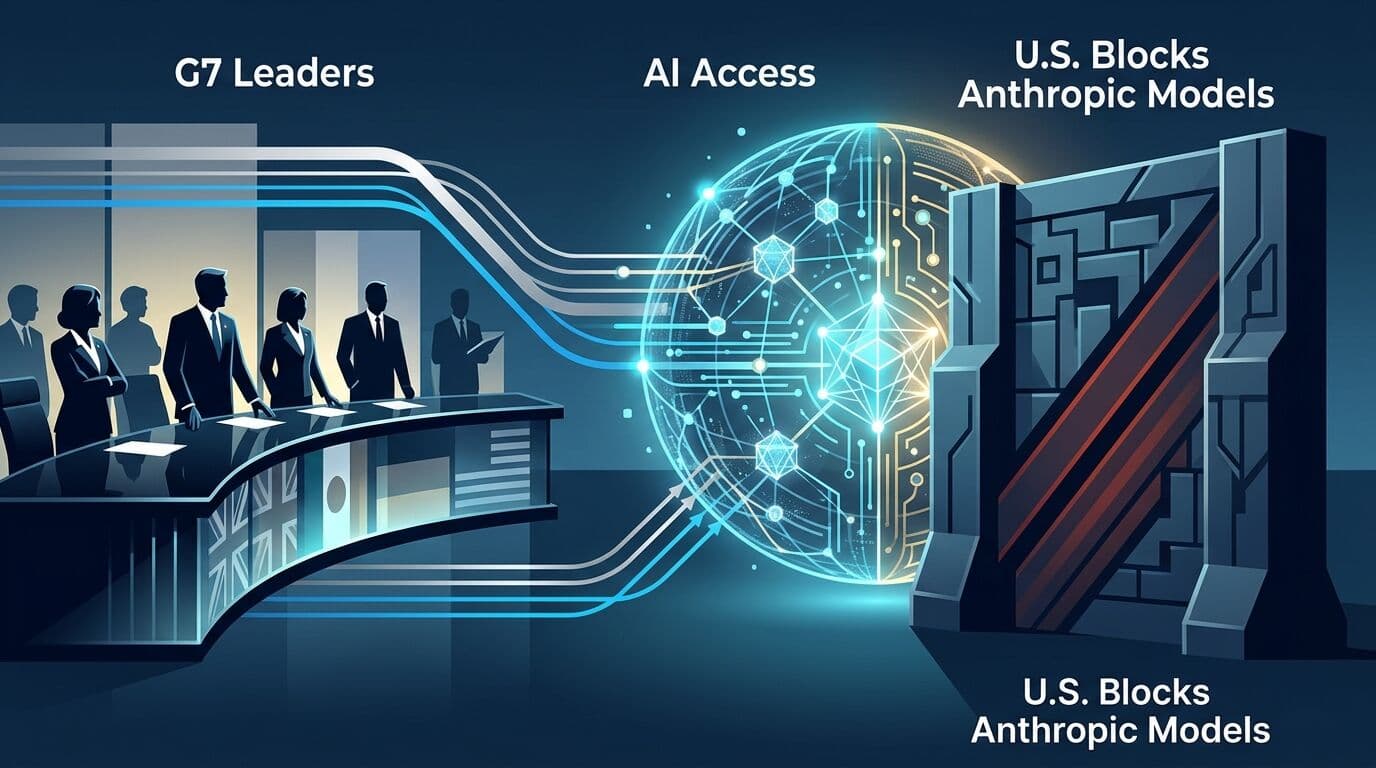
Macron and Modi raised alarms at the G7 Summit over the U.S. ability to cut off access to American AI models overnight, following the Trump administration's export block on Anthropic's newest systems.
World leaders at the G7 Summit on Wednesday pushed back against U.S. control over access to American artificial intelligence models, warning that the ability to revoke that access without notice poses serious economic and national security risks to allied nations. [1]
French President Emmanuel Macron addressed G7 leaders and top AI executives — including Anthropic CEO Dario Amodei and OpenAI CEO Sam Altman — warning that if the U.S. “from one day to the next can turn off the switch,” it could harm both European customers and the AI companies themselves. [1]
The remarks came days after the Trump administration blocked Anthropic from exporting its newest Mythos 5 and Fable 5 models, citing national security concerns. [1] The export restriction followed Amazon flagging to the White House that certain safety guardrails in the models could be bypassed. [1] Cybersecurity experts have argued that the capabilities cited by the government are also present in models that remain freely available, including from OpenAI, but Anthropic’s models remain blocked. [1]
Indian Prime Minister Narendra Modi also expressed concern over the Anthropic model block, according to reporting from the Financial Times, and said democratic nations must have unfettered access to top AI models to protect critical infrastructure. [1]
The episode has highlighted a broader vulnerability: any company or government that builds on U.S. AI infrastructure must now reckon with the possibility that access can be revoked overnight, for reasons they may never be told. [1]
Aidan Gomez, co-founder and CEO of Canadian enterprise AI firm Cohere, said in a statement that “companies and democratic nations remaining dependent on a small handful of big tech companies is dangerous to resilience,” adding that “digital sovereignty is not just about market competition or any one company or nation.” [1]
During the summit, G7 leaders discussed creating a “trusted partners” scheme that would grant non-U.S. nations access to advanced AI models from firms like Anthropic and OpenAI, structured as an open trade network designed to operate around U.S. export restrictions. [1] Both countries and companies could qualify as trusted partners, provided they used the models to develop stronger defenses against rivals such as China. [1]
The scope of any such scheme remains unclear, and it is uncertain whether it would provide relief for smaller startups in cities like Paris or Bangalore whose products could break without warning due to a sudden access cutoff. [1]
Macron argued that Washington itself would have an interest in backing the trusted partners framework, noting that no one would want to purchase U.S. AI access if it could disappear overnight. [1] The debate is unfolding even as European and other non-U.S. governments push for AI sovereignty — an increasingly difficult position to sustain as American models continue to lead the field and international actors seek to avoid being left behind. [1]
Sources
- TechCrunch — World leaders want American AI. They just don’t want America to be able to turn it off.
This article was drafted with AI from the cited sources and checked against them before publication. Spot an error? Let us know.