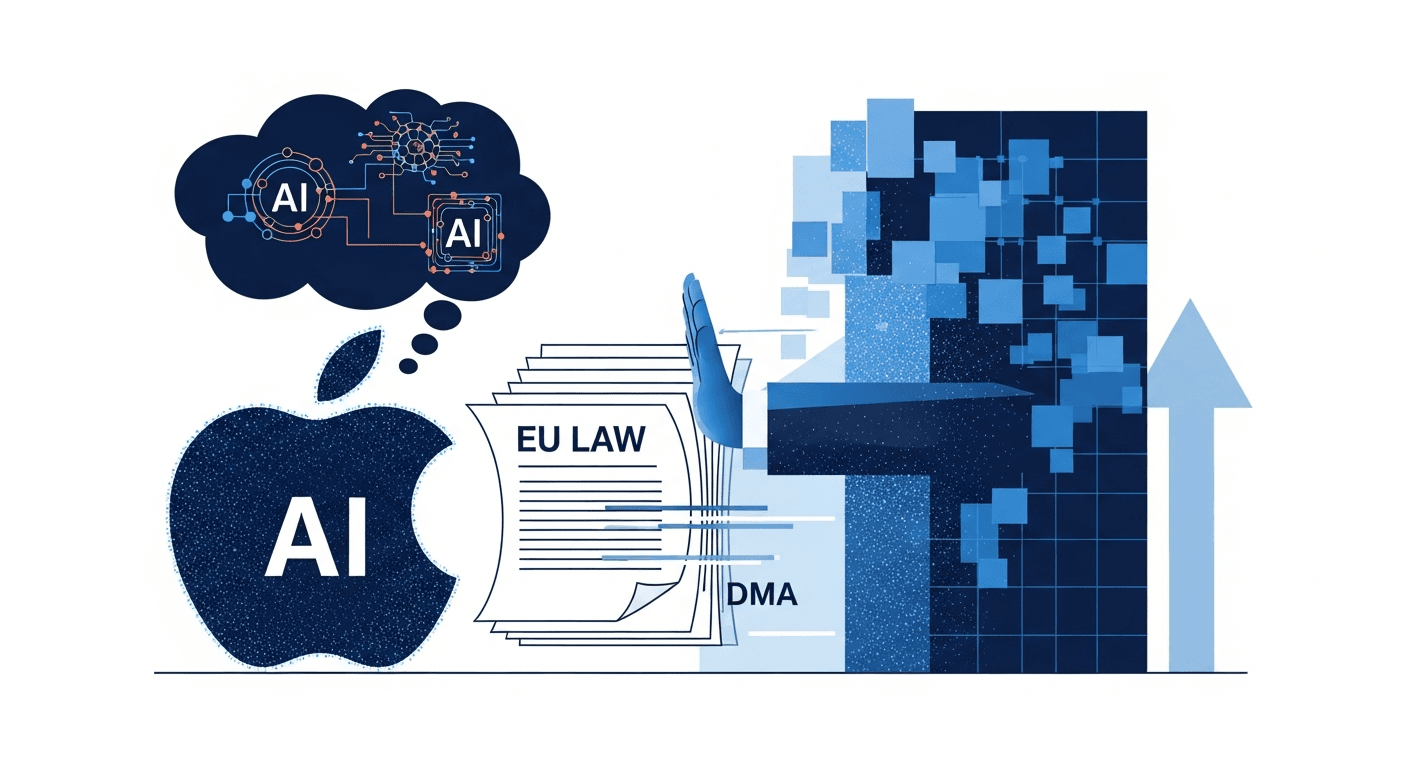
Apple says DMA interoperability rules make it impossible to launch its new AI-powered Siri in Europe; the European Commission says nothing in the law prevents Apple from doing so.
Apple has announced that its new AI-powered Siri will not launch on iPhones and iPads in the European Union, citing the bloc’s Digital Markets Act as the reason — a claim the European Commission flatly disputes. [1]
The DMA requires platforms designated as gatekeepers to give competitors the same kinds of data access they themselves enjoy, with limited exceptions. [1] For an AI assistant designed to access apps, personal information, photos, messages, and videos and take actions on users’ behalf, Apple argues that means handing over an enormous amount of system access to outside companies including OpenAI, Google, and Anthropic. [1]
Apple says such access would compromise the privacy and security of its customers. [1] The company proposed an intermediary mechanism it calls the Trusted System Agent, which it said would give rival AI agents comparable access and capability without direct system exposure, and said it would need 18 months to implement it on a “gradually rolling” basis. [1] Apple says the European Commission rejected that proposal and its others, leaving the company to declare that “there is currently no timeline for Siri AI’s availability in the EU on iOS and iPadOS.” [1]
Apple’s senior vice president of marketing Greg Joswiak, speaking at a press briefing, said the EU’s interpretation of the DMA would require giving others “unfettered access” to practically everything on a user’s device. [1] He added that the Commission has not “meaningfully engaged with us in our proposals.” [1]
The European Commission offered a direct rebuttal. “Nothing in the DMA prohibits Apple from introducing new products and services in the EU,” Commission spokesperson Ricardo Cardoso told The Verge. [1] Cardoso also stated that “Apple did not develop proposals for DMA compliant interoperability solutions,” a characterization Joswiak disputed. [1]
Apple took the unusual step of dedicating part of its WWDC 2026 keynote to explaining the European situation and published a blog post titled “Due to DMA, Siri AI delayed in EU for iOS 27 and iPadOS 27.” [1] China will also not receive Siri AI due to regulatory challenges, a fact Apple disclosed in a one-sentence footnote. [1]
Experts contacted by The Verge offered mixed assessments. Friso Bostoen, a professor of competition law and digital regulation at Tilburg University, acknowledged real security and privacy risks in forcing platforms to open their systems, but said Apple’s privacy arguments have not always withstood judicial scrutiny, pointing to recent court cases in the UK and US. [1] Jan Penfrat, a senior policy adviser for European Digital Rights, characterized Apple’s moves as “a lobbying tactic” aimed at pressuring the Commission to allow it to sidestep the DMA. [1]
Michael Veale, a professor of technology law and policy at University College London, argued that Apple is already making an exception to its own privacy model by giving Siri AI broad access across apps, but resists extending equivalent access to competitors. [1] Veale and Penfrat both noted that Apple has not made its proposed Trusted System Agent solution public, making independent assessment impossible. [1] Bostoen separately questioned why Apple would need 18 months to implement interoperability measures that were foreseeable and could have been developed alongside Siri AI itself. [1]
The dispute is not the first time Apple has cited DMA interoperability requirements to withhold features from European users; the company has previously attributed the absence of AirPods live translation, iPhone mirroring, and certain Maps features in the EU to the same law. [1]
Sources
This article was drafted with AI from the cited sources and checked against them before publication. Spot an error? Let us know.