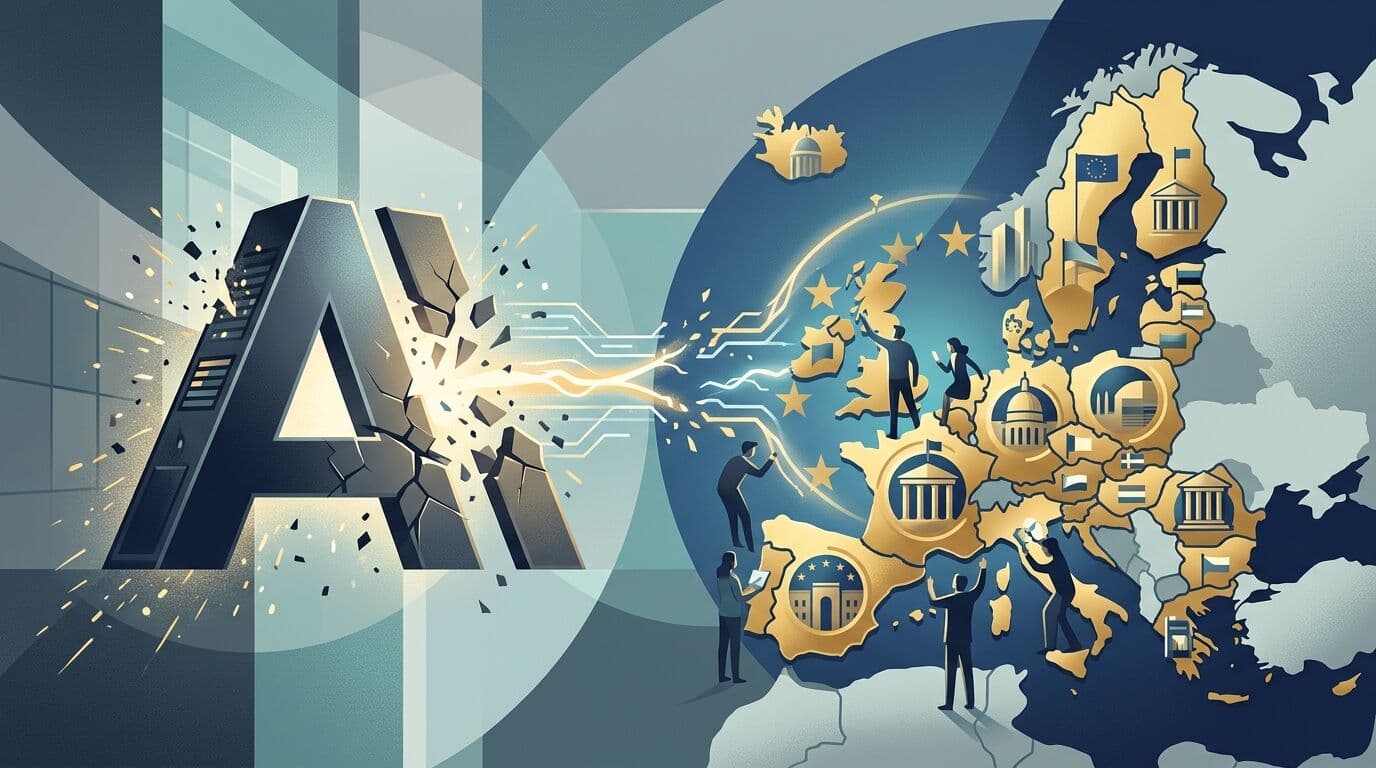
After the US barred non-US citizens from Anthropic's Fable 5 and Mythos 5 models, European officials and researchers are divided on whether Europe should build its own AI or negotiate better access terms.
The European Commission is assessing the fallout from a US government export control order that forced Anthropic to pull its Fable 5 and Mythos 5 models for all non-US citizens worldwide, reigniting a debate over Europe’s dependence on American artificial intelligence infrastructure. [1]
Thomas Regnier, the Commission’s spokesperson for technological sovereignty, told Euronews that any emergency measures must “not be discriminatory against partners,” describing the situation as “a further illustration of why Europe needs to strengthen its technological sovereignty.” [1] He framed it as “a shared challenge, not one confined to a single jurisdiction or company.” [1]
Anthropic pulled the models following a US government order tied to national security concerns, and talks to restore access are ongoing. [1] Anthropic CEO Dario Amodei is scheduled to join other leading AI company heads at a working dinner with G7 leaders. [1]
European researchers, in statements published by the Science Media Center, broadly agreed the episode was a wake-up call but diverged sharply on the appropriate response. [1]
Thorsten Holz of the Max Planck Institute for Security and Privacy called it striking that a single foreign government order could “shut down a model overnight for all non-US citizens,” including European businesses. [1] He argued that digital sovereignty does not require self-sufficiency, but rather the ability to use critical technology even during geopolitical conflicts. [1]
Konrad Rieck of TU Berlin went further, warning that US models can be “shut off at any time, sometimes for opaque reasons,” and arguing that Europe must develop and operate its own capable models. [1] Gitta Kutyniok of LMU Munich called for an “Airbus moment” for AI, with coordinated investment in foundation models, chip design, and energy-efficient computing. [1]
Paul Röttger of the Oxford Internet Institute pushed back on that view, arguing that “Europe won’t be able to develop models like Mythos or Fable 5 in competition with the US.” [1] He said access should instead be secured through contracts tied to data center investments and backed by credible trade policy threats. [1]
Other researchers highlighted the structural obstacles to building homegrown capacity. Matthias Hein of the University of Tübingen warned that Europe would need not just one but several domestic providers, since commercial companies cannot be relied upon to keep releasing open-weight models. [1] Jonas Geiping of the ELLIS Institute Tübingen noted that French AI company Mistral has “fallen far behind” over the past two years, and that the basic infrastructure — large-scale data centers and sufficient power generation — is lacking, with Germany’s power generation having dropped back to 1985 levels. [1]
Geiping also cautioned against treating the situation as analogous to nuclear weapons tensions, a comparison Anthropic itself has drawn. [1] Unlike nuclear weapons, he argued, AI is deeply embedded in the economy, meaning a shutdown during a diplomatic conflict could cause serious economic damage if business processes cannot function without access to capable AI systems. [1]
Sources
This article was drafted with AI from the cited sources and checked against them before publication. Spot an error? Let us know.