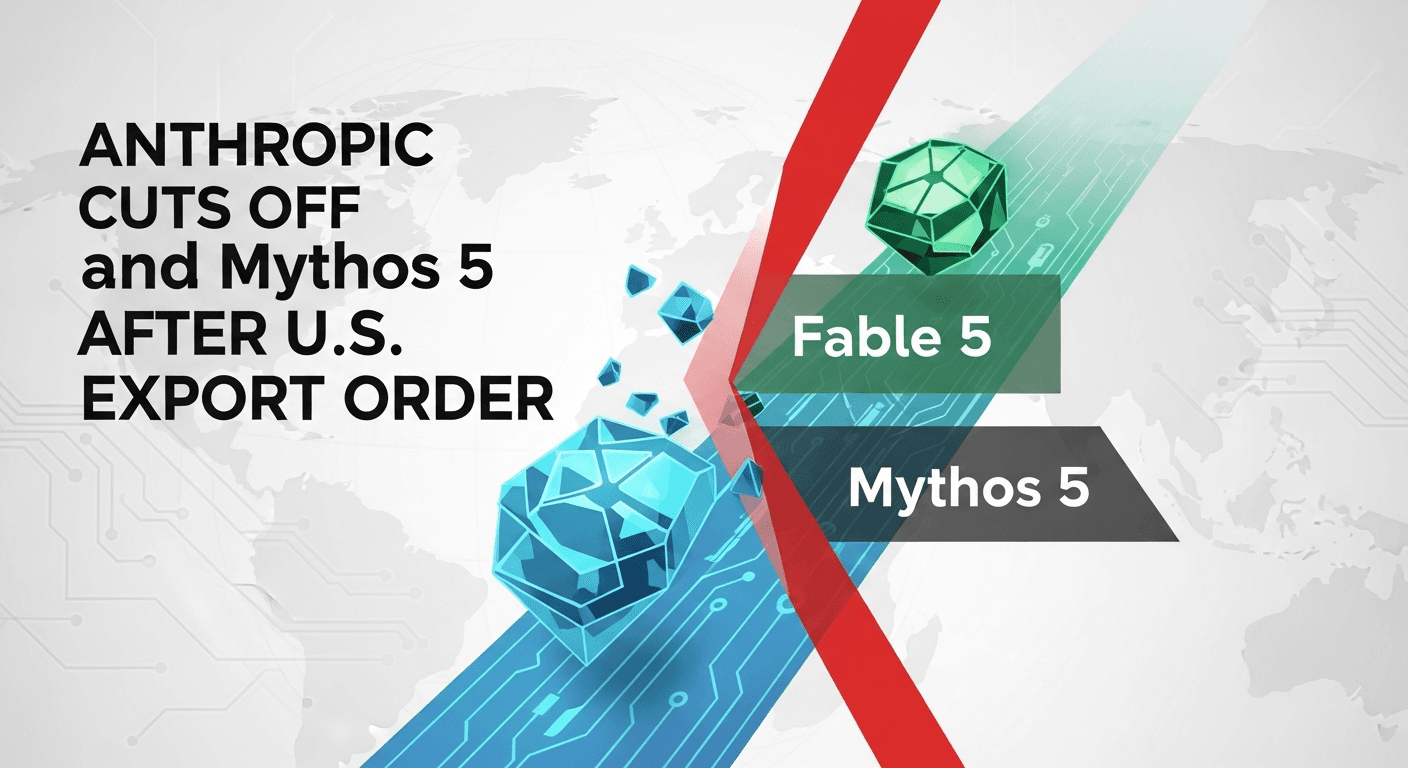
A government export control directive citing national security forced Anthropic to block all global access to its two newest frontier models, affecting paying enterprise customers and its own employees.
The U.S. government on Friday evening issued an export control directive ordering Anthropic to immediately suspend access to its Claude Fable 5 and Claude Mythos 5 models for all foreign nationals, citing national security concerns. [1,2] In response, Anthropic blocked all public access to both models globally — including for paying enterprise customers and Anthropic’s own employees. [2]
The shutdown came just three days after Fable 5 and Mythos 5 had been publicly released. [2] Users with active sessions on either model are now receiving errors, and new queries are being automatically routed to older models such as Opus 4.8. [2] Anthropic said in a blog post that access to all other Anthropic models remains unaffected. [2]
Anthropic said it is complying with the order but pushed back on its basis, stating that the government “did not provide specific details of its national security concern.” [1] The company said any evidence of a potential jailbreak was conveyed verbally rather than in writing. [1] In its public statement, Anthropic described the government’s disclosure as limited: “To date, the government has only given us verbal evidence of a potential narrow, non-universal jailbreak, which essentially consists of asking the model to read a specific codebase and fix any software flaws.” [2]
Anthropic further argued that the vulnerabilities identified were minor and not unique to its models, explicitly naming rival OpenAI’s GPT-5.5 as a system where similar capabilities are available. [1,2] In its statement, the company said: “We have not even received a disclosure of a concerning non-universal potential jailbreak that led to a harmful result.” [1] Anthropic also warned that pulling a commercial model over a non-universal jailbreak sets a regulatory standard that could “essentially halt all new model deployments for all frontier model providers.” [2]
The government action follows a viral jailbreak of Fable 5 published on X on June 10 by a user known as “Pliny the Liberator,” who claimed to have bypassed the model’s safety guardrails to extract instructions for cyber exploits, explosives, and chemical synthesis pathways. [2] The attacker reportedly used a multi-agent technique combining Unicode characters, homoglyphs, Cyrillic script, long-context reference tracking, and a method of breaking harmful requests into innocuous fragments before reassembling them using a previously jailbroken Opus model. [2] Anthropic did not confirm whether this specific jailbreak triggered the government order. [2]
Anthropic said it believes the shutdown is “a misunderstanding” and is working to restore access as soon as possible, and apologized to its customers. [2] The company also outlined steps it had already taken to safeguard the models, including working with U.S. and UK governments and updating its data retention policy to help track attempts at malicious use. [1]
The incident is not the first time Anthropic has faced U.S. government friction. In March 2026, Secretary of Defense Pete Hegseth labeled Anthropic a “supply chain risk” after the company declined to allow the military to use Claude for mass domestic surveillance and lethal autonomous weapons without safety restrictions, resulting in a prohibition on Anthropic’s use across defense supply chains. [2]
The sudden blackout has prompted discussion in the enterprise and developer community about the risks of relying on a single cloud-based AI provider. AI founder Alex Finn posted on X calling the Anthropic shutdown a “wakeup call” and urged developers to run local models on their own hardware, writing: “No company or government will EVER be able to take away your local models.” [2] Chinese open-source AI provider MiniMax highlighted the availability of its open-weights M3 model as a contrast to the centralized vulnerability exposed by the Claude shutdown. [2]
The episode illustrates a practical tension for enterprise buyers: closed-API frontier models offer the most advanced reasoning and agentic capabilities but depend entirely on vendor and regulatory continuity, while locally hosted open-weights models provide operational independence at the cost of cutting-edge performance. [2]
Sources
- The Verge — Anthropic cuts off Fable 5 and Mythos 5 access following government order
- VentureBeat — Anthropic blocks all public access to Claude Fable 5, Mythos 5 following US government order — what enterprises should do
This article was drafted with AI from the cited sources and checked against them before publication. Spot an error? Let us know.